It is necessary to safeguard the health of the trees, both for economic reasons and also because any damage to the tree will reduce its growth. Moreover, the fruits are damaged by these diseases and this will impact the production costs and the quality of the product.
Considering the high risks related to the residuals of pesticides in the olives and/or the oil, and also to meet specific economic needs, it has been necessary to review the problems related to the olive tree parasites in a more modern and correct way.
Firstly, the economic damage of the main parasites was evaluated, then less toxic active principles have been found out, and more modern control techniques have been adopted.
Before briefly describing the main parasites and the events that can damage the olive groves, we remind you that any agronomic intervention should be planned in the morning or in the evening, avoiding the central and hottest hours of the day.
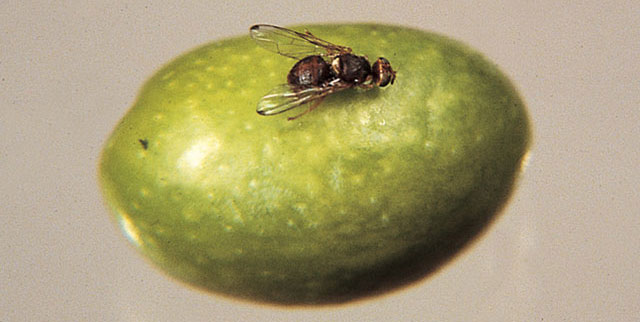
The dacus oleae is the most frequent insect that can seriously damage the olive groves productions in the Mediterranean area.
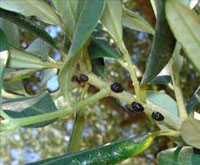
The Dacus attacks the fruits causing dark spots where the hole is made and the eggs are laid. The infestation is checked through chromotropic and chemotropic traps and by checking the damages to the fruits. Usually, the economic threshold for interventions for the oil olives amount to 10-15% of the infestation, and to about 5% for the table olives. Usually the right time to start defending the olive grove is when these thresholds are reached and the climate infos suggest a further development of the populations.
The prevention with hydrolyzed protein-rich baits is the most widespread because it doesn't damage the fauna, it is easy to apply and has a low cost. Should the thresholds become higher, a more active defence against this parasite is required. We suggest products containing phosphoric esters.
The olives attacked by Dacus fall early from the tree and can be used only to obtain oil, the oil yield of the stone fruits is more reduced and the oil obtained is more acid and needs adjustments.
Technically called "Prayas oleae", it is a small moth that on the olive tree creates 3 generations: one on the leaves, one on the flowers and one on the fruits.
The worst damages are caused by the two latter generations with the flowers destruction, and in worst cases with the small fruits drop.
It is necessary to act against this moth when the attack thresholds go beyond 20% of the flowers in the first part of June or 30% of stone fruits attacked between June and July. Usually, phosphor-organic products are quite effective (dimetoate, phosphamidone).
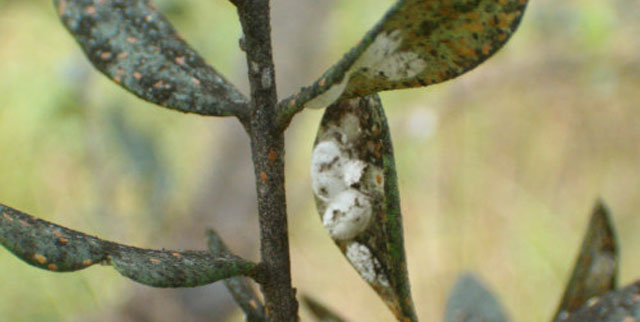
Many cochineal species attack the olive trees, but the most dangerous one is the "Saissetia oleae".
This parasite preferably attacks young branches and leaves, it produces a substance that covers the leaves thereby reducing the phosynthetic activity.
When treatments are necessary, light mineral oils are used in August and September when there are 30 male insects on 100 branches or 60 female insects on 100 branches.
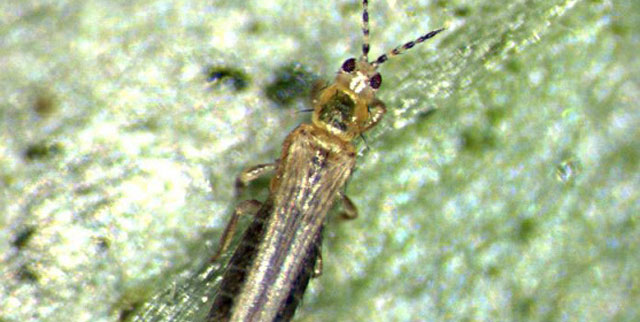
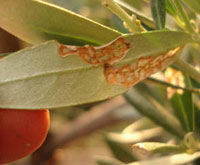
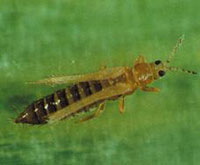
This small insect has a stinging and sucking mouth structure that it uses to attack the leaves, the flowers and the fruits, by creating hypertrophy, deformations, mutations and drop.
Usually. on the tree a depressive condition is visible, which becomes very evident in bad cases of infestations.
This parasite can be fought by using phosphoric esters in spring, when the wintering adult insects start their activity again.
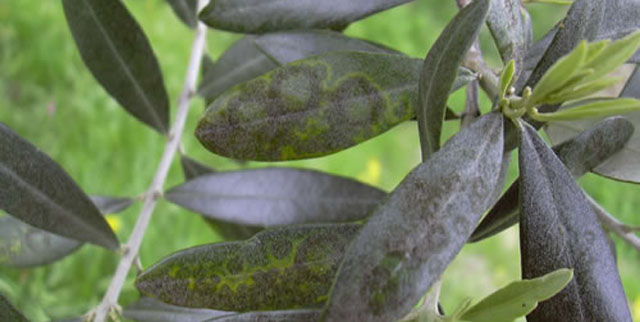
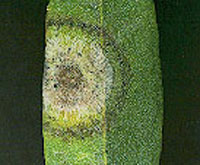
The "Spilocea oleagina" is a fungus that makes holes in the leaves.
Then, on the upper face of the leaves, some circular spots appear with a grey-reddish colour in the center and a brown colour on the edge.
A particularly serious attack causes the leaves abscission thereby affecting the antogenous differentiation of the buds.
This bacterium develops in autumn and in spring in presence of high humidity levels and with temperatures around 12°C.
The fight requires the use of fungicidal products in autumn and spring.
The scab, or tuberculosis, caused by the bacterium "Pseudomonas savastanoi", develops on the rind with hard and woody tubercles that reduces the vegetation and can even dry up entire branches.
The bacterium penetrates the trees through natural injuries due to frost, hail, insects or trimming, etc.
It is necessary to prevent this bacterium by using copper-based products.
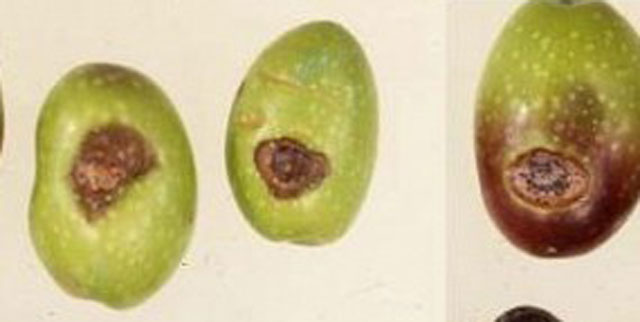
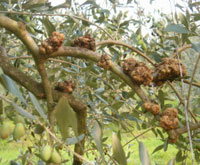
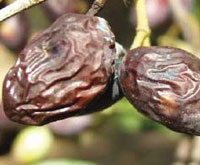
This disease is caused by the fungus "Gleosporium olivarum", that attacks the olives that are almost ripen, and rarely it attacks the tree during the vegetation.
At first the stone fruits show a rounded and dark sign, then they wrinkle and finally they fall. This fungus is present in southern areas and develops during humid autumns.
To prevent the attack of this fungus, it is necessary to avoid water stagnations. If the attack has already started, it is necessary to carry out 1-2 treatments in October and November, by using copper sulphate and lime mixture (Bordeaux mixture).
It is caused by different fungi species, like Capnodium, Cladosporium, Antennariella, Alternaria etc. The sooty mould is an alteration caused by the formation of a blackish layer of mycelium on the leaves, the branches and the fruits, with no alimentary relationship with the tree.
These fungi are developed and nourished by the sugary substances present in the physiological matter produced by the tree in particularly stressful moments. The most common causes for this disease are mainly cochineal attacks (especially the Saissetia oleae), trimming carried out after an exceedingly long interval, lack of phytosanitary defence, the use of wrong fertilizers, very mild winter temperature, the use of non-selective pesticides, etc. The damages mainly affect the reduction of photosynthesis activity and gaseous exchanges in the affected areas.
The sooty mould development can be effectively fought with an fungicidal treatment with copper salts, with periodical trimmings and well balanced fertilizers.
The fungus "Verticillium daliae" penetrates the tree through its roots and spreads out in the woody vessels, by causing their occlusion and then the drying up of one or more branches and/or the entire tree.
The sensitivity of the olive tree to the cold is affected by several factors, such as the cultivar variety, the vegetation stage of the tree, the exposure area, the air and ground humidity, the period f the year in which the temperatures drop.
When we have a sudden temperature drop, the leaves show a bronzy colour, they fall and the tree can loose many leaves. If the weather conditions are very bad, we have necrosis of the youngest branches, and later of bigger branches up to the main branches and even the collar.
The wind tends to have a mechanical and dehydrating action on the tree vegetation.
A frequent alteration due to brackish winds causes the drying up of the distal part of the leaf. Hot and dry winds in spring can affect the biological processes of fertilization.
The olive groves can be protected from winds by using windbreaks (nets, plants, etc).
Even though the olive tree adapts well to dry climates, if it lacks water for too long, it can have serious damages.
The young leaves dehydrate, the fruits don't grow, they fall and the growth slows down. To defend the tree it is necessary to water it, to carry out agronomical activities (superficial harrowing) that allow the water dispersion in the ground. The ideal solution is a drop-like irrigation system.
Abnormal chemo-physical conditions of the ground or wrong fertilizers could cause the lack of main nutrients (N, K, Ca), and this could alter the growth and/or the biology of the tree.
In the olive tree the most typical damage due to lack of nutrients is the lack of boron. Insufficient amounts of this element cause discolouring, drying up and leaves dropping, a reduced blossoming and fruit development, wrinkling of the branches, excessive development of plant suckers and growth of the buds in a rose-like shape.
To avoid the lack of this nutrient, you just have to add this microelement by fertilizing the leaves.